Why Red Team Engagements Beat Compliance Checklists
Compliance frameworks tell you what to check. Red teams show you what attackers actually do. Here's why evidence-based adversary simulation matters more than ticking boxes.
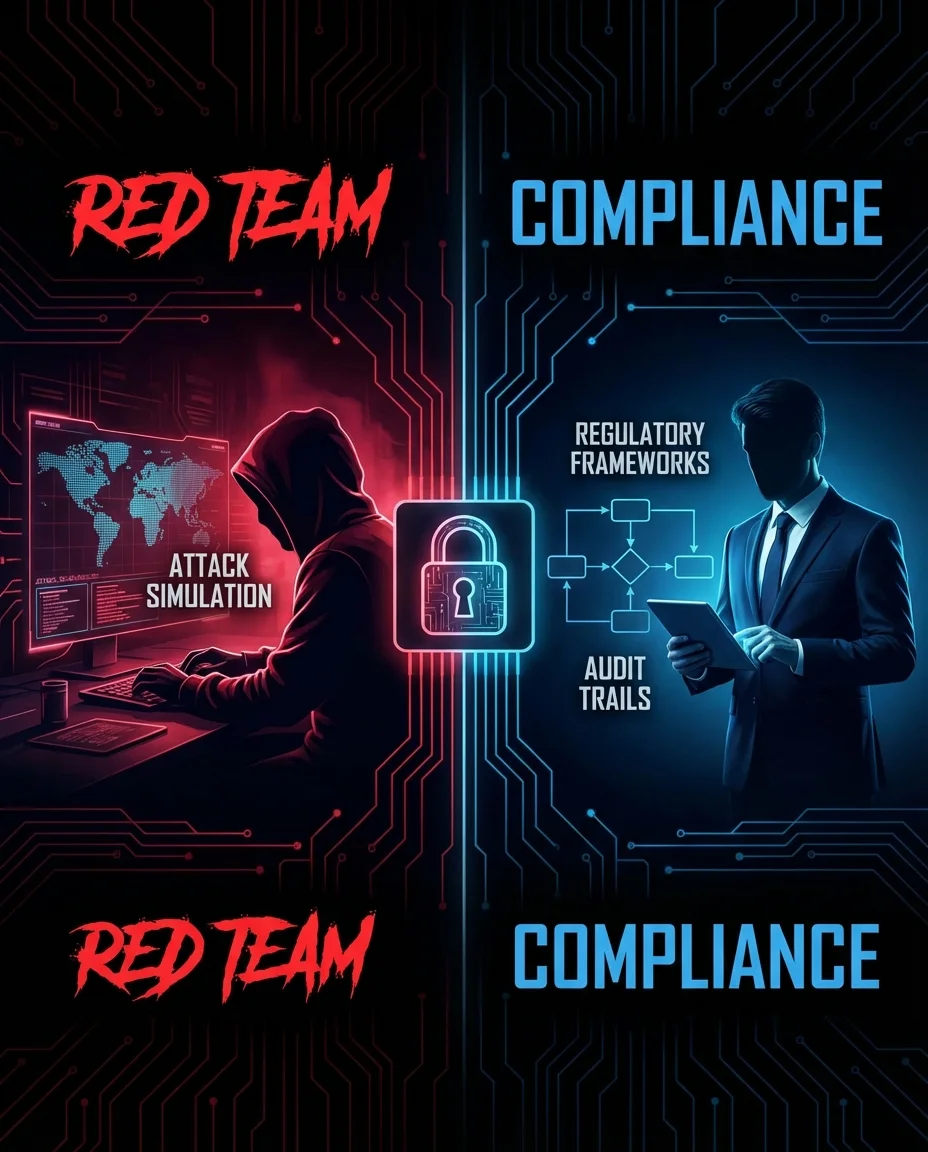
Every year, organisations spend millions on compliance audits. SOC 2, ISO 27001, PCI DSS â the list goes on. These frameworks provide structure and demonstrate due diligence to regulators and customers. But they share a fundamental limitation: they tell you what to check, not what an attacker would actually do.
Red team engagements take the opposite approach. Instead of verifying that controls exist, we simulate real adversaries. We think like attackers. We use the same tools, techniques, and tradecraft. The goal isn't to pass a checklist â it's to find what would actually get exploited in a real breach.
The Compliance Trap
Compliance audits are valuable. They establish baselines, enforce consistency, and satisfy contractual requirements. But they create a false sense of security. A system can be fully compliant and still be trivially exploitable. We've seen organisations pass penetration tests with flying colours, only to fall to a simple phishing campaign or a misconfigured cloud bucket.
The problem is scope. Compliance frameworks define a bounded set of controls. Attackers don't. They'll probe every vector â technical, human, physical. They'll chain vulnerabilities across systems. They'll exploit the gap between what the policy says and what actually happens on the ground.
What Red Teams Actually Do
A red team engagement starts with a question: "If a skilled adversary wanted to compromise this organisation, how would they do it?" We map your attack surface. We identify high-value targets. We build attack chains that cross technical and human boundaries. Every finding is evidence-based â we don't report theoretical risks. We demonstrate exploitation.
That evidence changes the conversation. When a CISO sees a screenshot of their crown jewels exfiltrated through a forgotten API, compliance checklists suddenly feel inadequate. When we show how a phishing link led to domain admin in 47 minutes, security awareness training gets taken seriously.
When to Use Each
We're not saying ditch compliance. Many organisations need it for regulatory or contractual reasons. The point is to layer red team work on top. Use compliance for baseline assurance. Use red teaming for reality checks. Schedule red team engagements before major audits â find and fix the real issues first, then let the audit verify the controls.
At Open Data Security, we deliver both. Our red team engagements are scoped, authorised, and evidence-based. We work with UK enterprises and government programme stakeholders who need more than a tick in a box. If that sounds like you, get in touch.
Operational Implications
The key takeaway from this topic is execution discipline: identify exploitable paths early, assign ownership quickly, and validate remediation under realistic conditions. Teams that operationalise security into release and change workflows generally reduce high-risk exposure windows and avoid repeat findings.
Use this insight to prioritise what is exploitable now, what can chain into broader impact, and what should be validated again after fixes are deployed. Evidence-led prioritisation consistently produces faster and more durable risk reduction than checklist-only approaches.
Implementation Checklist
- Define a clear owner for each critical finding and remediation deadline.
- Validate exploitability before and after remediation with reproducible evidence.
- Document impact in business terms for leadership, not just technical severity.
- Schedule follow-up verification so fixes are confirmed, not assumed.
Related Next Steps
Translate this topic into action by aligning the right engagement model to your current risk profile. For targeted validation, start with Red Teaming. For practical examples of measurable outcomes, review Hybrid Cloud Red Team. You can also browse the latest guidance in our blog archive.
Need a Practical Plan?
If you want this assessed against your own environment, we can scope it quickly and provide an evidence-focused route to remediation. Get in touch and we will recommend the most effective next step based on your architecture, timeline, and risk priorities.
Need Help Applying This?
If this topic relates to your environment, we can scope the right engagement model and provide a clear plan with evidence-focused outcomes.